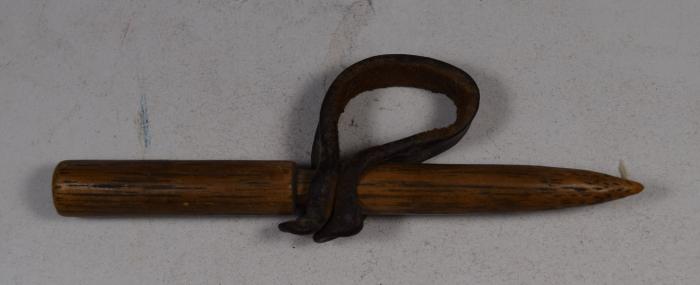
Cornhusker, Hand
1.1.362
from the collection of
Dimensions
5 in. L Item (Overall)
Description
Cornhusker, Hand: Husking pin used by Peter Rodde. The pin is made out of wood with a band carved out half the way up the pin where a strip of leather is attached that fits around a finger.Corn is the most valuable grop grown in North America. Corn, native to Latin America, has been under cultivation in North America for centuries. Hardy, disease resistant and nourishing, it was the principal crop of the Indians long before th Europeans corssed the Atlantic The pioneers soon found that corn made a nourishing livestock feed. They departed from the Indian method of stripping the ripened ears from the standing stalk preferring to cut the stalk close to the ground to save the fodder for winter feed.
Their first tools were sharpened hoes and long corn knives or machetes. Some even converted old scythe blades into short-handled corn knives. The next improvement, the corn "hook," allowed a man to cut the stalk close to the ground without stooping.
Another form of corn cutter developed by the pioneers was the lef knife. A sharp blade was strapped to the boot and braced to the knee in the same way a telephone lineman's climbing irons are fastened. The laborer kicked vigorously at each stalk to sever it. "The American cornbelt" was practically built on the husking pin, a hook or pin strapped to the hand to permit quick opening of the sheath that holds the precious ear of corn. There were dozens of models and adaptations.