Archaeological Artifact(s) 21PO046
2018.4386
from the collection of
Title
Archaeological ArtifactsDescription
Artifacts found during the 2017-2018 Pope County Archaeological Survey.Although conditions were poor, five items were found during the survey.
Lithics included a Knife River Flint (KRF) flake tool, and a flake of heat-treated Swan River Chert. The expedient KRF tool is a tabular piece, possibly the distal end of a thick flake. There is crude bifacial retouch on the thin margin, producing a sharp but irregular working edge. Many of the flakes did not travel well and end in step terminations. Some small flake scars may be use wear, although the edge is not obviously worn.
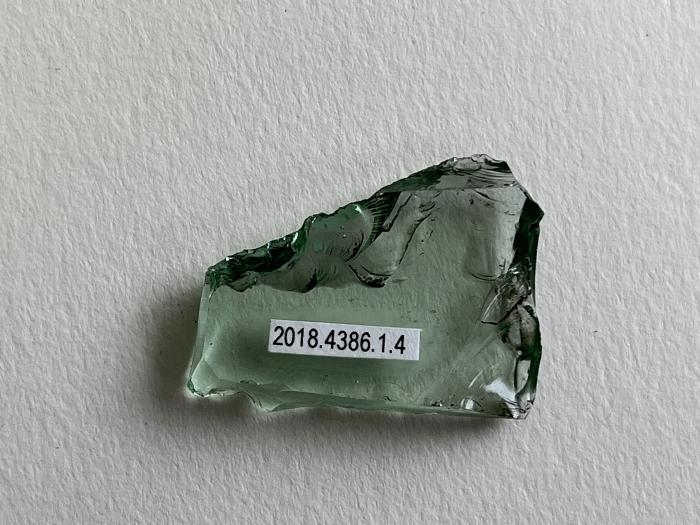
Historic artifacts included an industrially manufactured white earthenware sherd, probably from a steep-sided bowl, and a fragment of green bottle glass.
White earthenware, also known as whiteware, is ubiquitous on historic sites and is extremely hard to date, but dates tend to cluster in the second half of the nineteenth century.
The bottle glass represents a fragment of a cylindrical, straight-sided mold-blown bottle. Thickness is 4mm.The light aqua color indicates a refined glass. The original bottle was likely a standard cylindrical spirits bottle manufactured in the second half of the nineteenth century. Three sides have simple breakage scars that are typical of glass found in archaeological surveys. One corner has a flaked hertzian cone that has created a pointed, graver-like point. The fourth side has a series of overlapping invasive flakes that have gradually thinned the bottle wall down to a possible cutting edge. A segment of this thinned edge appears to have regular pressure flaking to further sharpen the edge. Abraded edges are suggestive of use wear, while abrasions are completely lacking on the flat internal and external surfaces of the bottle fragment. In all, the piece of glass appears to be a tool that was created by using traditional lithic tool technology to create an expedient tool.