Archaeological Artifact(s) 21PO070
2018.4390
from the collection of
Title
Archaeological ArtifactsDescription
Artifacts found during the 2017-2018 Pope County Archaeological Survey.Artifacts included lithics: a chert scraper tool and three flakes of Swan River chert, one of which was heat treated. Nine bone fragments were recovered in the immediate vicinity of the flakes, including one long bone fragment from a large mammal and eight small unidentifiable fragments that were calcined by burning. Four artifacts are bottle glass, and two are potentially from the same squared sided vessel. Some glass on this site has formed an unusual matte surface due to weathering and soil chemistry caused by exposure to the elements. This slightly obscured diagnostic elements. Two glass artifacts with a similar decolorized color could be from a square-sided whisky or medicine bottle. One is the side of a squared bottle, possibly with a tapered shape. Most rectangular bottles from the historic period have inset panels that advertised their contents as patent medicines. This bottle had a roughly rectangular shape but does not have inset panels typical of patent medicinal shapes. Instead, the squared off (but not chamfered) corners could conform to a liquor bottle shape classified as “tall square, long-necked spirits bottle” that was common in ca.1890s through 19201.This style was commonly produced in decolorized glass similar to the sherds found. One sherd has a similar shape to the side of this bottle type, and one has the same style neck and finish.
The flat side fragment has no distinguishing manufacturing marks besides evidence that it was mold blown and that impurities in the glass were trapped next to the mold on the bottle exterior. The bottle finish (the bottle neck to rim) is referred to a “brandy” style and was common on spirits bottles including whisky. The finish also has manufacturing marks that can be dated: a standard bore with no evidence of added glass. There are no mold marks on the upper lip to rim indicating that the bottle was hand finished with a tool. However, there are mold lines both under and above the “ring” and a slight bore constriction near where the mold marks fade. These characteristics are all indicative of an “improved” tooled finish of a mold blown bottle made between 1885 and ca.1910. This date is also consistent with the bottle style and glass color date.
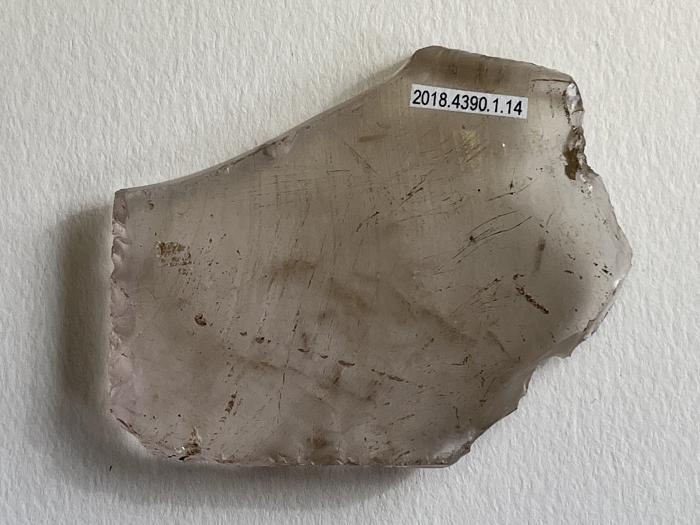
The most interesting information from the bottle fragment derives from the reuse of a large side sherd after it was broken(Figure 1). This glass piece was modified using traditional lithic (stone) tool manufacturing methods that were retained by Indigenous people well into the nineteenth century as they continued to traverse an ancient trail network. Flakes were removed in regular pattern from the inside of one side of the sherd to create a cutting edge. This could have been used as a scraper since flakes were not removed from the flat exterior of the bottle sherd. This sherd also has an unusual number of scratches and peck marks, including many on the interior side that would not relate to use wear as a container for liquids. Some of the scratching and abrasions may have been created during use of the glass sherd as a sort of multi-tool before being lost or discarded. Other glass is smaller and thinner with no reuse.
One undecorated refined earthenware (whiteware) plate rim completes this collection. It could easily date to the second half of the 19th century—the same period as the bottle glass.